
Artificial Flower Pricing Tiers | Silk to Real Touch
Compare value silk, mid-tier, and Real Touch artificial flower lines by buyer fit, MOQ 500-576 pcs/style, samples, margin logic, and RFQ checks.
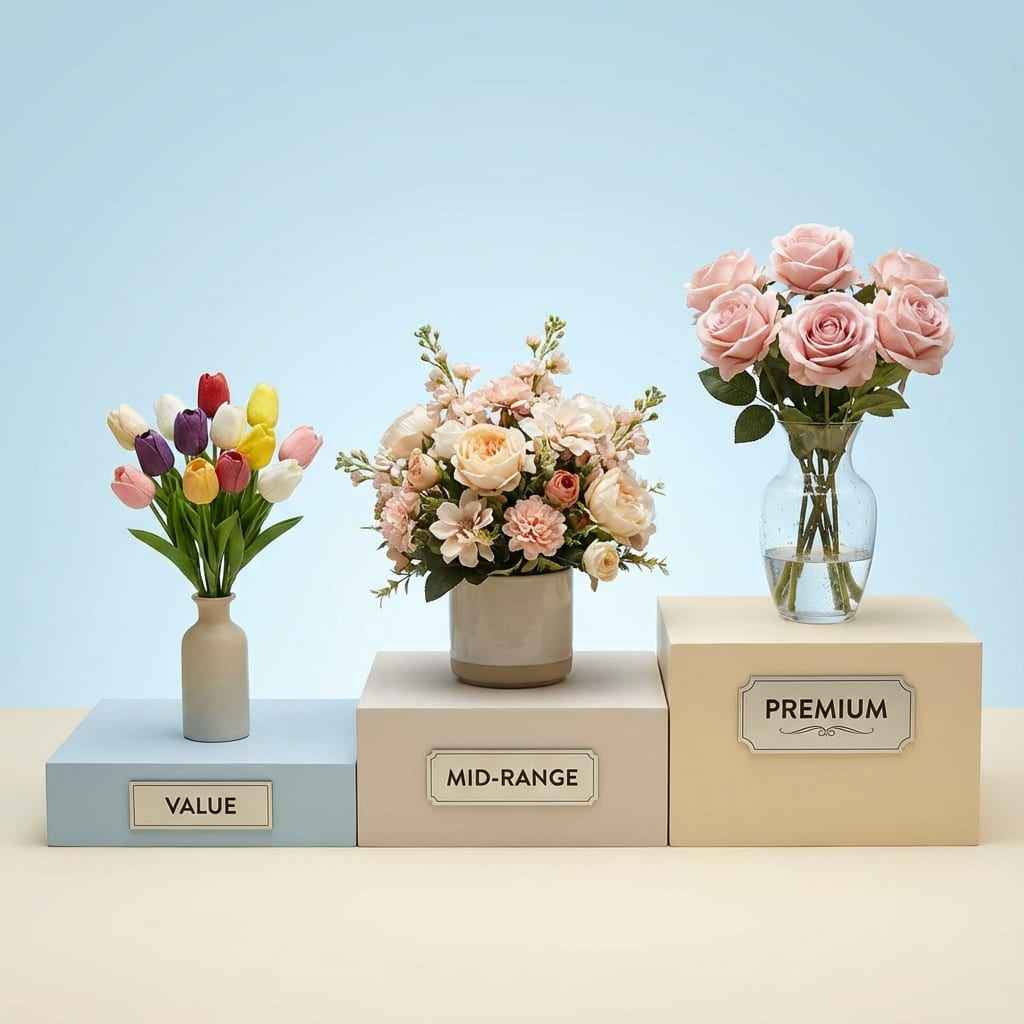
Direct Answer: Artificial Flower Pricing Tiers for Wholesale Buyers
Wholesale artificial flower pricing tiers usually separate value silk flowers, mid-tier improved silk or blended finishes, and premium Real Touch flowers. The right tier depends on buyer channel, target retail price, viewing distance, margin plan, MOQ, sample budget, packing method, and whether customers will touch or photograph the flowers close up.
For importers, retailers, wedding suppliers, event companies, and artificial flowers business owners, the goal is not to buy the cheapest stem. The goal is to build a profitable assortment where budget, mid-range, and premium lines each have a clear job.
Key Takeaways
- Artificial flower pricing tiers should be planned by customer channel, not only by factory unit price.
- Value silk flowers support seasonal, background, and price-sensitive programs.
- Mid-tier silk or blended finishes often work for mainstream retail, florists, and general event inventory.
- Premium Real Touch flowers fit weddings, hotels, premium retail, and close-view artificial flower arrangements.
- Different tiers justify different MOQ investments, sample priorities, packing methods, and margin expectations.
- Typical Everbloom terms are MOQ 500-576 pcs/style, samples about 15 days, bulk production 60-90 days, and FOB Xiamen.
Wholesale Artificial Flower Pricing Tier Snapshot
| Buyer question | Practical answer |
|---|---|
| Value tier | Standard silk flowers for price-sensitive retail, seasonal decor, background installs, and volume programs |
| Mid-tier | Better silk, improved color, stronger construction, and broader assortment coverage for mainstream wholesale |
| Premium tier | Real Touch flowers using latex, PU, or similar coatings for close-view, photo-heavy, or high-margin programs |
| Best margin logic | Value lines turn faster; premium lines can create higher absolute margin and stronger differentiation |
| Main pricing drivers | Material, flower size, petal detail, stem construction, MOQ, color count, packing, carton volume, and QC |
| Best RFQ method | Share target retail price, buyer channel, quality tier, reference photos, quantity by style, and destination port |
Understanding Artificial Flower Product Tiers
Value Tier (Standard Silk)
Product Characteristics:
- Basic construction and materials
- Standard fabric petals without coating
- Simpler color palettes
- Essential formats (single stems, basic bundles)
Target Customers:
- Price-sensitive consumers
- Volume decorating projects
- Craft and DIY applications
- Seasonal/disposable use cases
- Broad retail displays where the flowers are viewed from a distance
Wholesale Positioning:
- Lower unit cost, solid margins at volume
- Compete on price accessibility
- Emphasize “looks good from a distance”
- Keep SKU count controlled so value lines do not consume all MOQ budget
Mid-Tier (Enhanced Quality)
Product Characteristics:
- Better construction and finishing
- Improved color accuracy
- Some texture enhancement
- Wider variety of styles
Target Customers:
- Quality-conscious value shoppers
- Home decor enthusiasts
- Smaller event decorators
- Retail florist supplement inventory
- Artificial flowers business buyers testing a mixed assortment
Wholesale Positioning:
- Sweet spot for many wholesalers
- Balance of quality and price acceptance
- “Better than basic” messaging
- Useful when buyers need visible quality gains without moving every SKU into Real Touch pricing
Premium Tier (Real Touch)
Product Characteristics:
- Latex or PU coating for realistic feel
- Superior color gradients and detail
- High construction quality
- Full style range including specialty items
Some suppliers and buyers describe this tier as True Touch, Natural Touch, Soft Touch, or Real Touch. Treat those names as positioning language until samples confirm the material. If your premium line brief uses True Touch wording, compare the RFQ against the True Touch flowers wholesale supplier guide before committing MOQ to a bulk program.
Target Customers:
- Wedding and event professionals
- Luxury retail and hospitality
- Photography and film production
- Premium home decor consumers
- Hotel, restaurant, and commercial decor buyers using flowers near eye level
Wholesale Positioning:
- Highest absolute margins
- Differentiation from commodity competition
- Premium experience justifies premium pricing
- Best reserved for hero stems, close-view arrangements, and SKUs customers compare by touch or photo
How Pricing Strategy Changes by Buyer Channel
Wedding and event suppliers: prioritize premium Real Touch roses, orchids, peonies, magnolias, and focal flowers for bouquets, centerpieces, and photography-led work. Use silk or mid-tier filler for background volume.
Retailers and importers: build a good-better-best ladder. Use value silk flowers for entry price points, mid-tier stems for mainstream buyers, and Real Touch SKUs for premium shelf differentiation.
Hotel and commercial decorators: put budget into close-view areas first: reception desks, restaurant tables, suites, and showroom displays. Use silk or greenery for large background fill where tactile realism matters less.
Artificial flowers business owners: avoid starting with too many tiers at once. Pick a target customer, define the expected retail price, sample the key quality levels, then scale the tier that fits repeat demand.
Building a Multi-Tier Wholesale Assortment
Portfolio Strategy
Typical Distribution:
- Value: 20–30% of SKU count
- Mid-tier: 30–40% of SKU count
- Premium: 30–40% of SKU count
Adjust based on your specific market and customer base.
Category Coverage
Apply tiers by category, not evenly across every product type:
- Roses: value, mid-tier, and premium Real Touch can all make sense because roses serve retail, wedding, event, and arrangement programs.
- Orchids: mid-tier and premium Real Touch usually work better than the lowest-value tier because buyers often use orchids close up.
- Peonies and focal blooms: premium or mid-tier investment is easier to justify for wedding and event customers.
- Greenery and filler stems: value or mid-tier often controls landed cost in large installations.
- Basic stems: value and mid-tier are usually enough unless the stem is part of a premium close-view arrangement.
Inventory Depth
Volume by Tier:
- Value: Higher quantities, faster turn
- Mid: Moderate quantities, steady demand
- Premium: Strategic quantities, margin focus
Remember: MOQ 500–576 pcs/style applies across tiers.
Margin Considerations by Tier
Value Tier Margins
- Lower absolute margin per unit
- Relies on volume for profitability
- Competitive pressure on pricing
- Watch inventory turns carefully
- Packing efficiency matters because low-price SKUs are more sensitive to freight and carton volume
Mid-Tier Margins
- Moderate margin per unit
- Balanced volume and margin returns
- Less price sensitivity than value
- Good foundation for wholesale business
- Often the best first sampling path when buyers are unsure about customer tolerance for premium pricing
Premium Tier Margins
- Highest absolute margin per unit
- Lower volume, higher value transactions
- Less competition at quality level
- Worth MOQ investment for differentiation
- Needs clearer product photography, sample approval, and customer education
Supplier Pricing Factors Behind Each Tier
Wholesale artificial flower pricing is not only material cost. When comparing suppliers, ask how these factors change the quote:
- Material path: standard silk, improved fabric, latex coating, PU coating, silicone-like finish, flocking, foam, wire, or mixed foliage.
- Flower complexity: petal count, color gradient, hand assembly, stem length, leaf detail, and whether the bloom must hold shape in packing.
- MOQ and color count: more colors, smaller runs, or complex mixed-SKU orders usually increase coordination cost.
- Packing method: loose stems, bunches, bouquets, in-vase arrangements, fake water sets, inner boxes, carton protection, and barcode labels change landed cost.
- QC requirement: batch consistency, color control, shedding checks, stem rigidity, and pre-shipment inspection add value but must be planned.
- Freight economics: FOB Xiamen price is only one part of landed cost; carton size, CBM, compression risk, and FCL/LCL planning affect final margin.
RFQ Checklist for Artificial Flower Pricing Tiers
To get useful pricing from a supplier, include:
- Buyer channel: importer, retailer, florist, wedding supplier, event company, hotel, commercial decorator, or artificial flowers business.
- Target tier: value silk, mid-tier silk, premium Real Touch, or mixed good-better-best assortment.
- Target retail or resale price range, if available.
- Reference photos, flower types, stem length, color palette, and expected viewing distance.
- Quantity by style and color, plus whether mixed-SKU consolidation is needed.
- Packing needs: loose stems, bunches, bouquets, in-vase sets, fake water, labels, barcodes, inner boxes, or carton marks.
- Destination port, sample deadline, bulk delivery window, and expected reorder plan.
Quality Verification Across Tiers
Sample Before Committing
Request samples from each tier you plan to stock:
Value Tier Evaluation:
- Acceptable “arm’s length” quality
- Basic construction that holds up
- Color that photographs reasonably
- Price-appropriate expectations
Mid-Tier Evaluation:
- Noticeable quality improvement over value
- Closer inspection acceptability
- Better color accuracy
- Worth the price step-up
Premium Tier Evaluation:
- Close-up realism under scrutiny
- Real Touch texture quality
- Premium construction details
- Justified for premium positioning
Side-by-Side Comparison
Evaluate tiers together:
- Photograph samples from each tier
- Assess quality gaps visually
- Determine price/quality trade-offs
- Confirm positioning strategy
Communicating Tier Differences to Customers
Value Positioning Language
“Beautiful artificial flowers at accessible prices” “Perfect for volume decorating and seasonal displays” “Great look from conversation distance”
Mid-Tier Positioning Language
“Quality artificial flowers for discerning decorators” “Enhanced detail and color accuracy” “Worth the investment for lasting arrangements”
Premium Positioning Language
“Real Touch artificial flowers that feel like the real thing” “Photography-ready quality for professional applications” “Premium materials and construction for lasting luxury”
Common Wholesale Strategies
Good-Better-Best Approach
Present three clear options to customers:
- Good: Value tier at entry price
- Better: Mid-tier with quality upgrade
- Best: Premium/Real Touch for top applications
Category Specialization
Focus premium investment in high-margin categories:
- Premium: Roses, orchids, peonies (wedding drivers)
- Mid/Value: Greenery, basic stems (volume drivers)
Market Segment Focus
Align tiers with customer segments:
- Event wholesale: Premium focus
- Mass retail supply: Value/mid focus
- Specialty retail: Mid/premium focus
B2B CTA: Build Your Product Range
Ready to develop multi-tier inventory?
- View all products — Browse wholesale artificial flower product lines
- Bulk artificial flowers wholesale — Plan mixed-SKU and volume programs
- Silk flowers wholesale — Compare value and mid-tier silk options
- Real Touch Flowers Wholesale — Review premium close-view flower lines
- True Touch flowers wholesale supplier guide — Compare True Touch, Natural Touch, and Real Touch premium labels
- Request samples — Compare tiers side-by-side
- Check MOQ & Best-Seller List — Review curated wholesale tiers
- WhatsApp — Discuss tier strategy
Trade Terms (All Tiers):
- MOQ: 500–576 pcs/style
- Samples: ~15 days
- Bulk: 60–90 days
- FOB Xiamen | Sea freight
- 1,000㎡ showroom in Xiamen
Frequently Asked Questions
What are artificial flower pricing tiers?
Artificial flower pricing tiers usually separate value silk flowers, mid-tier improved silk or blended finishes, and premium Real Touch flowers. Each tier serves a different buyer channel, margin target, MOQ plan, and quality expectation.
How do wholesale artificial flower prices differ between silk and Real Touch?
Silk flowers usually sit in value or mid-tier programs because fabric petals are lighter and simpler to produce. Real Touch flowers usually cost more because latex, PU, or similar coatings add realism, weight, production steps, and quality-control requirements.
Should a new artificial flowers business start with budget or premium lines?
A new artificial flowers business should start from its customer channel. Wedding, hotel, event, and premium retail buyers usually need Real Touch or higher-detail lines. Broad seasonal retail or background decor programs can start with value or mid-tier silk flowers.
What affects wholesale artificial flower pricing?
Wholesale artificial flower pricing depends on material, flower size, petal detail, stem construction, MOQ, color count, packing method, carton volume, sample changes, QC needs, and FOB or freight planning.
Do you offer all three quality tiers?
We offer Real Touch premium lines and select mid-tier options. Our focus is quality-oriented product for serious wholesale buyers.
Is MOQ different for value products?
MOQ structure (500–576 pcs/style) applies across our range. Mixed-SKU consolidation can be discussed for order optimization.
Can I mix tiers in one order?
Yes. Many buyers order across categories and quality levels in single shipments for efficiency.
What should buyers include in a pricing tier RFQ?
Include buyer channel, target retail price, preferred quality tier, reference photos, material preference, quantity by style, color range, packing needs, destination port, sample deadline, and expected reorder plan.
How do quality tiers affect pricing?
Premium Real Touch products are often priced 30–50%+ above value equivalents. The margin impact depends on your market positioning, pricing strategy, and customer segment.
Should new buyers start with value or premium?
Depends on your market. If serving weddings/events, start with premium. For general retail, testing mid-tier may be prudent.
Can value products be improved with display techniques?
Yes, but quality differences are inherent. Better display helps, but premium quality creates genuinely different customer experiences.
Suggested Internal Links
- Real Touch Explained
- Real Touch Flowers Wholesale
- True Touch flowers wholesale supplier guide
- Silk Flowers Wholesale
- Bulk Artificial Flowers Wholesale
- Wedding Market Guide
- Quality Control
- Artificial flowers wholesale product lines
- Submit wholesale RFQ
Everbloom Florals is a trade-and-supply-chain integrated B2B wholesale partner for artificial flowers based in Xiamen, China. We support sampling, sourcing coordination, QC, and bulk delivery for global wholesale buyers, retailers, and project clients. We do not operate retail florist services.
Ready to Source Real Touch Flowers?
MOQ 500–576 pcs/style · Samples ~15 days · Bulk 60–90 days · FOB Xiamen · Sea freight (FCL/LCL)
Real Touch wholesale sourcing cluster
Real Touch flowers wholesale China supplier
Latex-coated artificial flowers from a Xiamen B2B supplier. MOQ 500–576 pcs/style, samples ~15 days, QC coordination, and export-ready packing.
Real Touch artificial flowers wholesale guide
Real Touch artificial flowers wholesale material guide for latex/PU options, MOQ 500–576 pcs/style, samples, QC, FOB Xiamen, and sea freight planning.
Real Touch flowers wholesale suppliers
Real Touch flowers wholesale suppliers guide for comparing China manufacturers, export partners, samples, MOQ, QC, packing, and FOB Xiamen terms.
Where to buy Real Touch flowers wholesale
China wholesale buying paths for Real Touch flowers, including supplier checks, MOQ 500–576 pcs/style, samples, and FOB Xiamen planning.
Real Touch flowers wholesale bulk orders
Real Touch flowers wholesale bulk guide for planning SKU mix, MOQ 500–576 pcs/style, samples, production 60–90 days, packing, FOB Xiamen, and sea freight.
True Touch flowers wholesale supplier guide
True Touch flowers wholesale supplier guide for comparing True Touch florals, latex, PU, samples, MOQ, packing, RFQ details, and FOB Xiamen terms.
Real Touch vs silk flowers wholesale
Compare Real Touch and silk artificial flowers for wholesale assortments, landed cost, premium SKUs, and volume programs.